In graduate school, I did research in experimental ultrafast optics, which deals with optical pulses that are extremely short in time, known as ultrashort pulses (less than 10-12 seconds). I conducted this research at the University of Colorado under the direction of Prof. Thomas Schibli.
Why is ultrafast optics important?
Ultrashort pulses are often generated by lasers through a process known as “mode locking” (2.2.1). They are the shortest events humans have ever created, which makes them useful for a wide range of applications including frequency metrology, spectrally pure microwave generation and spectroscopy (1.1). To time an event, you need a “clock” whose precision is finer than the event you’re measuring.
Here’s an example. Imagine a road trip from Denver, CO to Vancouver, BC. According to Google Maps, the drive takes 21 hours and 57 minutes (assuming the Canadian border guards know you’re an important scientist and wave you straight through). A typical car clock has one minute of precision, so if you time the trip with it you’ll get something close to 21 hours and 57 minutes. Great: the car’s clock is precise enough to measure this drive.
Now imagine you get bored crossing southern Idaho and decide to use the same clock to time how long it takes to travel between the white dashed lines on the highway. At southern Idaho driving speed (about 70 mph, depending on your tolerance for speeding tickets), with lines about 30 feet apart, that takes 30 ft ÷ 70 mph ≈ 0.29 seconds. That’s far shorter than the clock’s one-minute precision, so you’ll measure either 0 minutes or 1 minute (if the minute happens to tick over during those 0.29 seconds). Both answers are very wrong. To measure this event accurately, you’d need a timer with much finer precision, like an atomic clock. That’s the crux of why ultrashort pulses are so useful for measuring events on very short time scales, such as atomic transitions (1.1.3).
Frequency combs
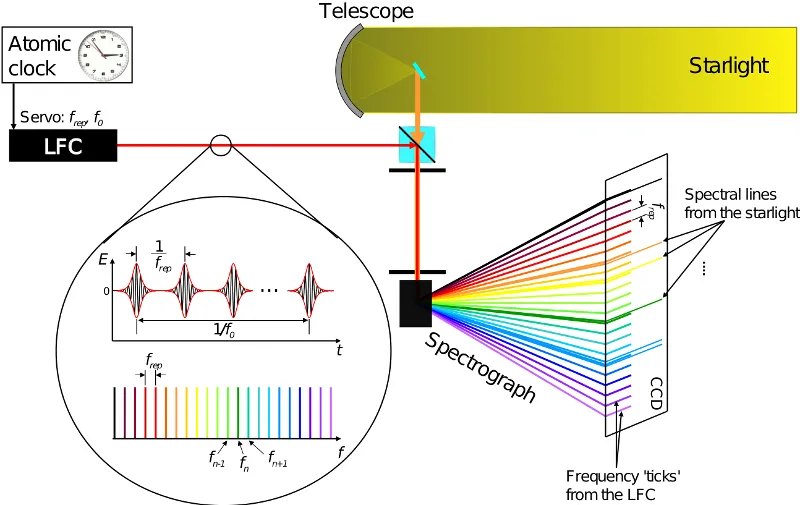
Another application of ultrashort pulses is generating “frequency combs.” They get their name because they look like a hair comb in the frequency domain, where each tooth of the comb is a different frequency (shown as different colors in the figure below). A properly stabilized frequency comb can be used to measure arbitrary frequencies of light (1.1).

Frequency combs can also improve the precision of metrology and spectroscopy instruments. For example, they can be used to calibrate astronomical spectrographs, which could soon let astronomers precisely measure the redshift of distant celestial objects. Those measurements could help confirm or rule out theories of dark energy. An example of such a setup is shown below.
My contribution
My thesis focused on a method to stabilize the repetition rate of these light pulses, fr, which is the inverse of the time between pulses. Several methods already existed (3.1.3), but my method (3.2) set out to reduce their complexity. It succeeded in reducing timing jitter (a measure of fluctuation, or noise, in the repetition rate) at least four-fold over the range from 100 Hz to 10 MHz.
More resources
- An animation explaining the basics of how lasers work (video with sound)
- An in-depth explanation of frequency combs by Dr. Rüdiger Paschotta, RP Photonics Encyclopedia
- University of Colorado, Department of Physics